
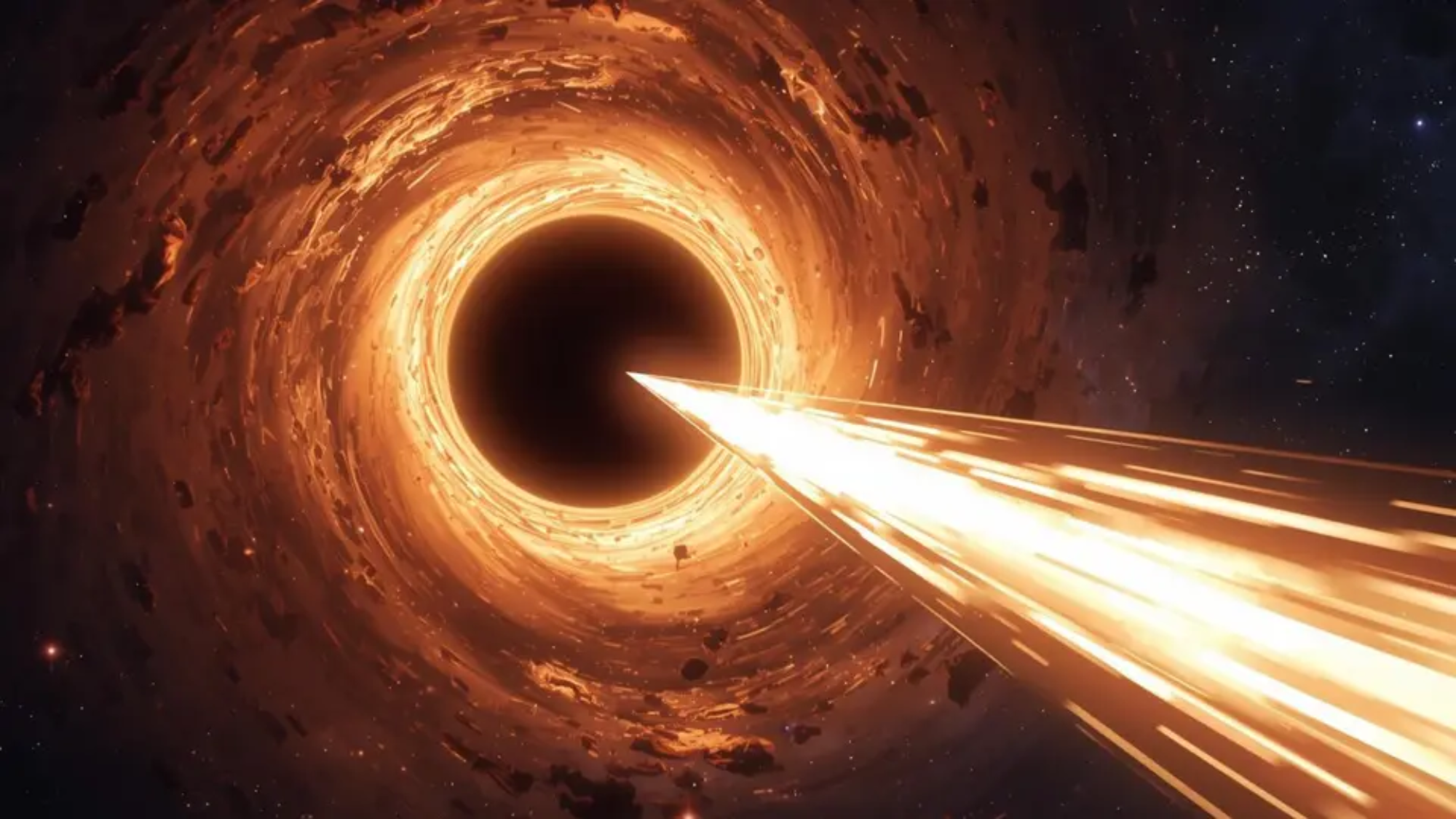
A supermassive black hole at the center of the galaxy SDSS J110546.07+145202.4, located 1.8 billion light-years away, is feeding on matter at rates previously observed only in the early universe, shortly after the Big Bang. The intense accretion behavior provides a nearby laboratory for studying how the most distant and ancient supermassive black holes grew. Radio observations revealed the source, with emissions increasing 20-fold around eight years ago to roughly 10 quadrillion times the sun's radio brightness -- a transition into a sustained radio-bright state that has not been documented before in this type of system.
The team, led by Stefanie Komossa at the Max-Planck-Institute for Extraterrestrial Physics, published their findings in The Astrophysical Journal in May. The galaxy appears to represent a new class undergoing rapid radio emission changes, with the black hole's increased mass consumption driving the growth of relativistic plasma jets. Researchers expect the system will become a key target for future radio surveys, particularly using the incoming SKA telescopes, to identify similar transients and constrain models of black hole and galaxy evolution in the early universe.