
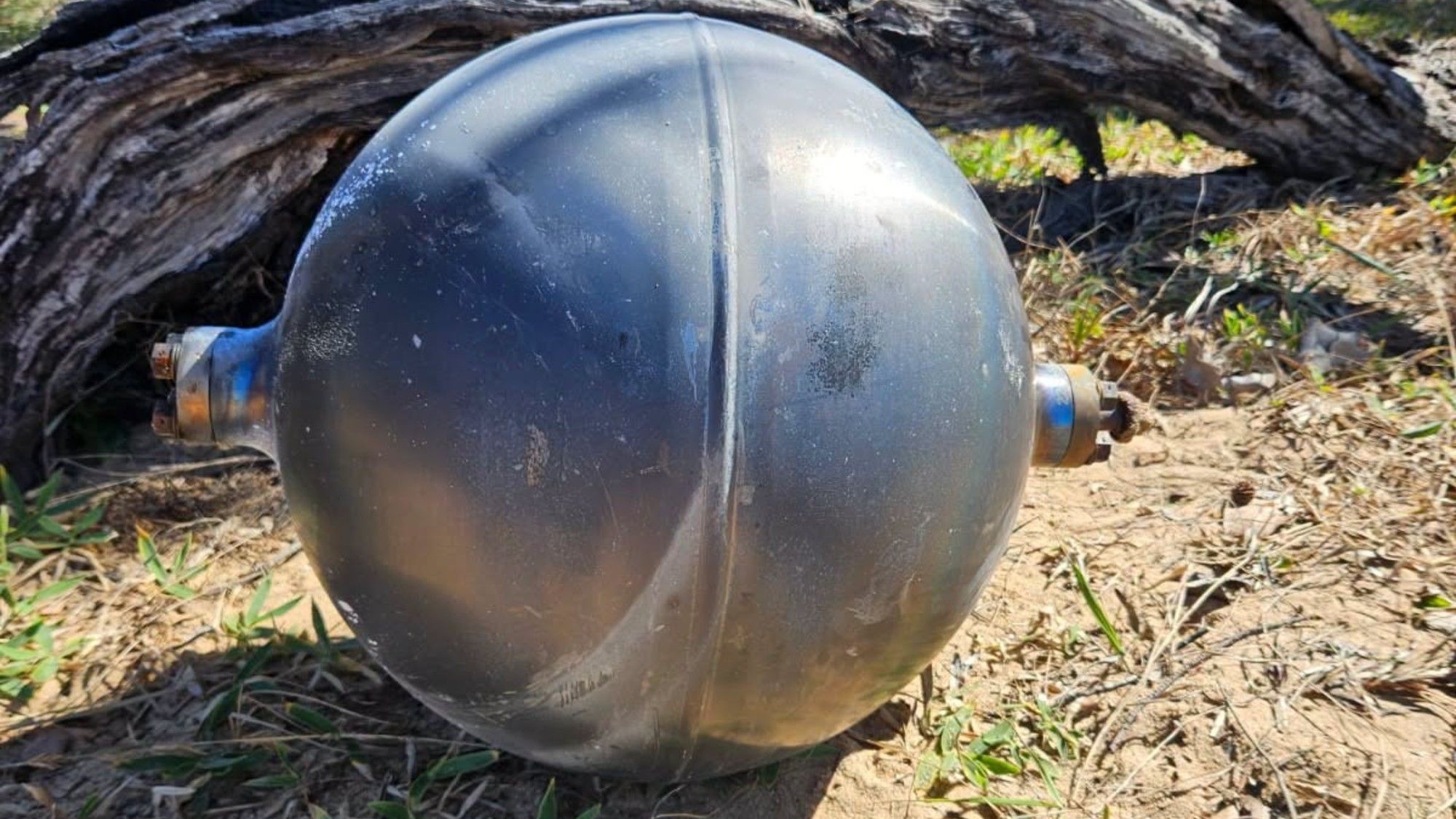
In early July, the Australian Space Agency reported the recovery of six spherical metal objects -- likely pressure vessels from a rocket upper stage -- found in Forrest Beach, Queensland. The discovery marks another instance of space debris landing in Australia, joining a pattern that includes Skylab debris in 1979, SpaceX Dragon components in 2022, an Indian booster vessel in 2023, and a Chinese Jielong-3 rocket section in October 2025. Experts say the incident underscores how much remains unknown about debris reentry and survivability, and highlights the need for better tracking and controlled end-of-life disposal practices.
Marlon Sorge, executive director of the Aerospace Corporation's Center for Orbital and Reentry Debris Studies, explained that pressure vessels survive reentry largely because of their construction materials and design. Objects made of titanium or Composite Overwrapped Pressure Vessels (COPV) are particularly resistant to heat damage and decelerate more gently than solid metal chunks. Their shape allows them to "float down" rather than plummet, and their durability means they often reach the ground intact and recognizable.
The broader issue, according to Sorge, is that many debris incidents result from uncontrolled reentries that could be prevented. Responsible space operators should conduct controlled reentries in unpopulated areas rather than allowing upper stages to fall randomly. Michelle Hanlon, executive director of the Center for Air and Space Law at the University of Mississippi, noted that identifying debris country-of-origin through labeling is impractical since objects unlikely survive reentry intact; better solutions involve improved tracking and information-sharing among space agencies. Hanlon also pointed out that more debris incidents reflect increased launch activity -- a sign of sector growth -- rather than declining safety, as reentries succeed safely 99.9 percent of the time.
Experts stress that end-of-life disposal has become as critical to responsible space operations as launch itself. Sorge welcomed debris analysis from recovery efforts, as studying intact pressure vessels provides insights into reentry physics and material survivability. Hanlon emphasized that tracking incoming debris and obtaining precise reentry times and locations would significantly improve the ability to identify debris origin. The Australian finds represent ongoing knowledge gaps in how materials and objects behave during atmospheric reentry.