
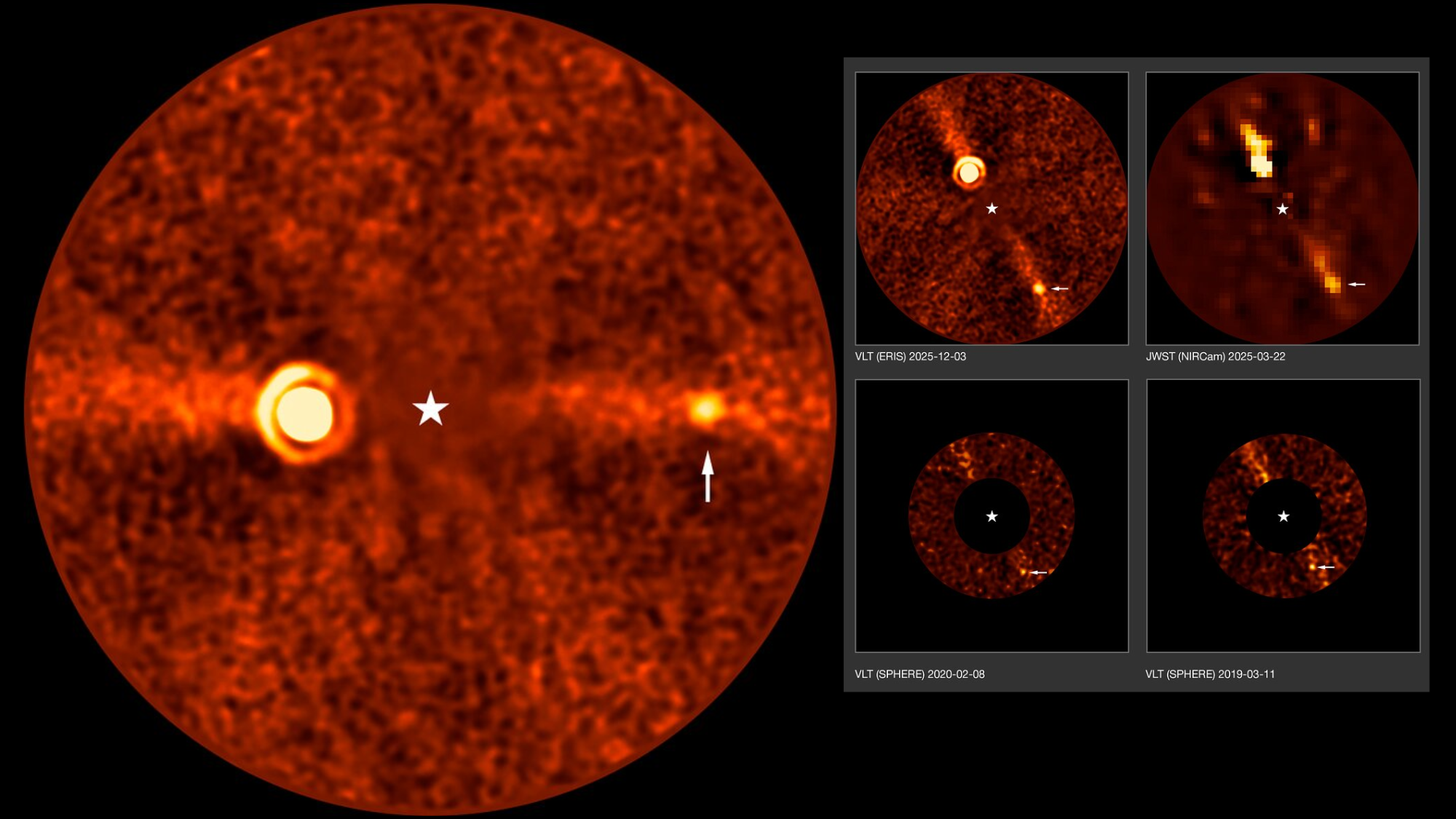
Astronomers directly imaged Beta Pictoris d, an exoplanet 63 light-years away that marks the faintest world ever seen from Earth using this method. The discovery came after more than a decade of archival work -- the team initially studied the system's known planet Beta Pictoris b but spotted signs of a third world hiding in old data. Beta Pictoris d is a gas giant with about 2.4 times Jupiter's mass, making it one of the lightest exoplanets ever directly imaged from ground telescopes, and its location and mass solve a long-standing puzzle about the system's dust and debris disk.
The Beta Pictoris system now becomes only the second known system with multiple directly imaged planets, after HR 8799. Direct imaging of exoplanets remains rare -- fewer than 100 of NASA's over 6,000 cataloged exoplanets have been discovered this way, since it requires isolating a planet's thermal glow from its star's glare. The finding suggests other faint planets may be waiting in similar systems, and upcoming instruments like the Extremely Large Telescope in Chile could reveal them. The team published the work in The Astrophysical Journal Letters on July 15.