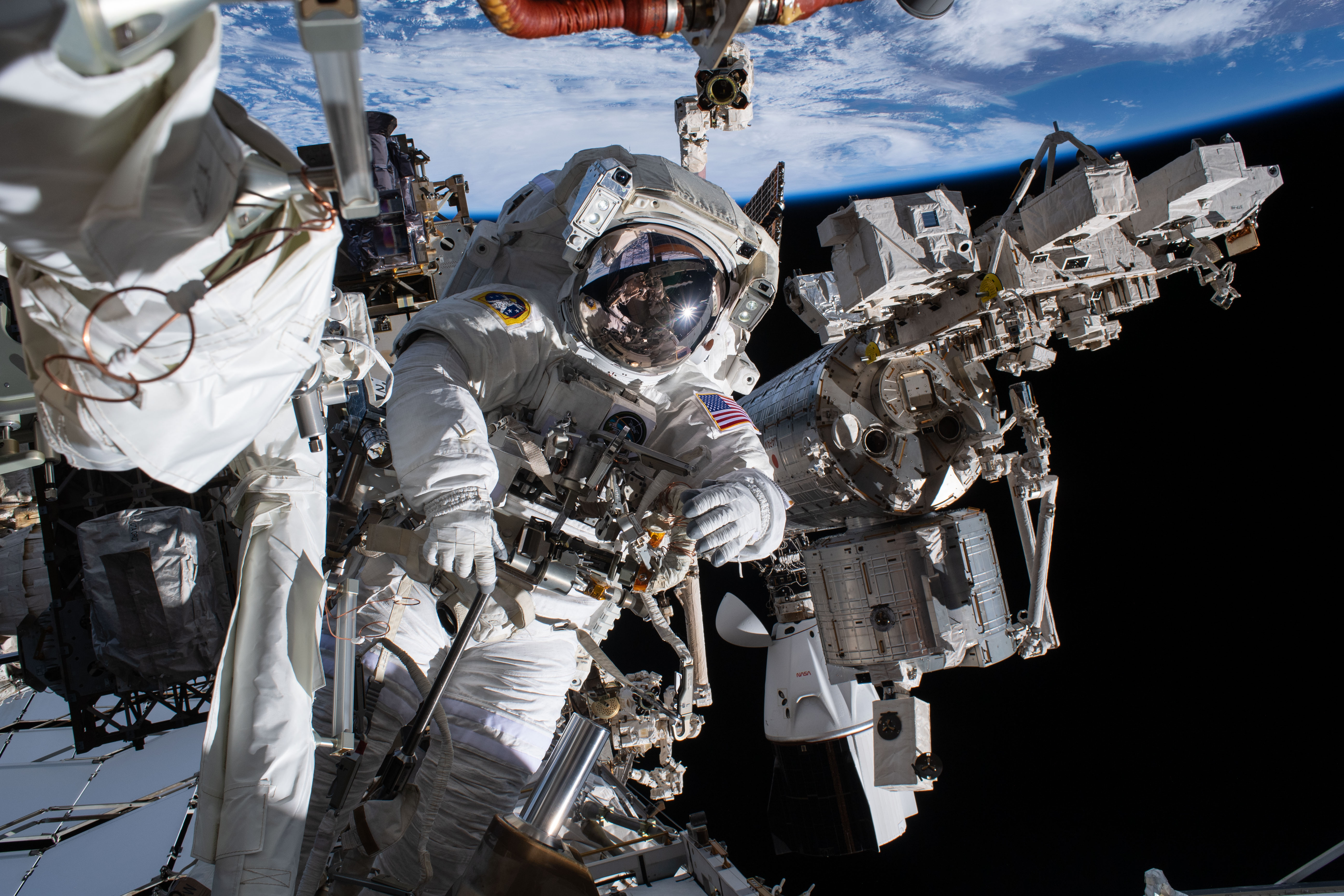
NASA astronaut Chris Williams is returning to Earth after eight months aboard the International Space Station for his first mission. During his assignment, Williams completed two spacewalks, contributed to cancer treatment research, advanced semiconductor crystal production, and supported multiple other experiments that aim to benefit life on Earth and future lunar and Mars missions. His work demonstrates the space station's role in both near-term scientific advancement and long-term human spaceflight preparation.
Williams participated in DNA-inspired material research designed to enable targeted cancer therapies that can penetrate solid tumors and release medicine in controlled ways. He also conducted semiconductor crystal growth experiments in microgravity, where researchers can produce more crystals of desired sizes than possible on Earth, with applications for high-performance computers, artificial intelligence systems, and medical devices. These efforts establish groundwork for future commercial manufacturing in space.
During his two spacewalks, Williams helped repair the Canadarm2 robotic arm and prepared the station for new solar arrays. The final set of International Space Station Roll Out Solar Arrays (IROSA) will increase the station's power generation by roughly 30 percent once installed in a future spacewalk. The same solar array technology has powered NASA's Double Asteroid Redirection Test and could support future Moon and Mars missions.
Williams also worked on biofilm prevention using ultraviolet light to keep water systems and equipment clean during long-duration missions, collected biological samples for studying spaceflight's effects on the human body, and supported protein crystal growth research for pharmaceutical development. He participated in cargo capture operations and robotic systems testing that will inform design improvements for future autonomous equipment on the station and beyond.