
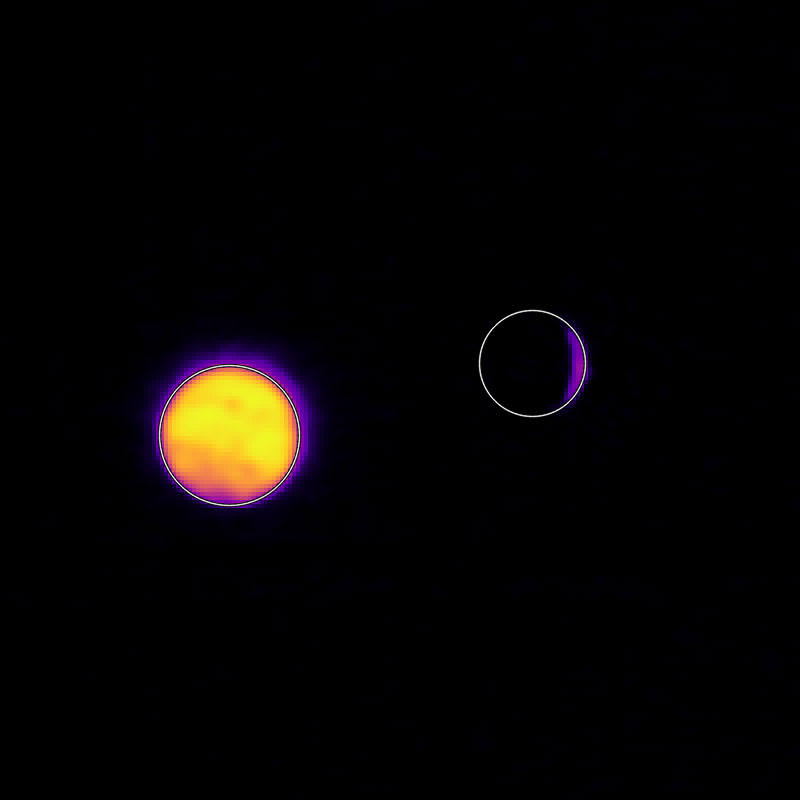
One of NASA's two ESCAPADE spacecraft captured images of Earth and the Moon on July 3 while positioned 363,250 miles from Earth and 115,600 miles from the Moon. The spacecraft used visible and thermal infrared cameras to photograph both bodies, revealing Earth and Moon as crescents with only about 8% of each face sunlit. The images serve dual purposes: they provide calibration data for ESCAPADE's instruments ahead of the mission's science phase, and they demonstrate the cameras' ability to detect faint Martian aurora and thermal signatures once the spacecraft reaches Mars.
In visible light, the Sun-reflected crescent images show limited illumination. The thermal infrared images reveal a stark contrast between the two bodies. Earth's shadowed hemisphere glows with heat from its atmosphere and surface, ranging from minus 10 to minus 44 degrees Fahrenheit. The Moon's far side, lacking atmospheric insulation, remains far colder at minus 280 degrees Fahrenheit.
ESCAPADE consists of two spacecraft built by Rocket Lab, now stationed in a loiter orbit around Lagrange point 2, about a million miles from Earth. The mission is led by UC Berkeley's Space Sciences Laboratory with support from Rocket Lab, NASA's Goddard Space Flight Center, Embry-Riddle Aeronautical University, Advanced Space, and Blue Origin. Funding comes from NASA's Heliophysics Division through the Small Innovative Missions for Planetary Exploration program.
The spacecraft will remain at Lagrange point 2 until November 2026, when they will perform a gravity assist flyby of Earth to redirect toward Mars. They are scheduled to arrive in Mars orbit in September 2027, where they will investigate how solar wind interacts with the Martian atmosphere and drives atmospheric loss at the planet.