
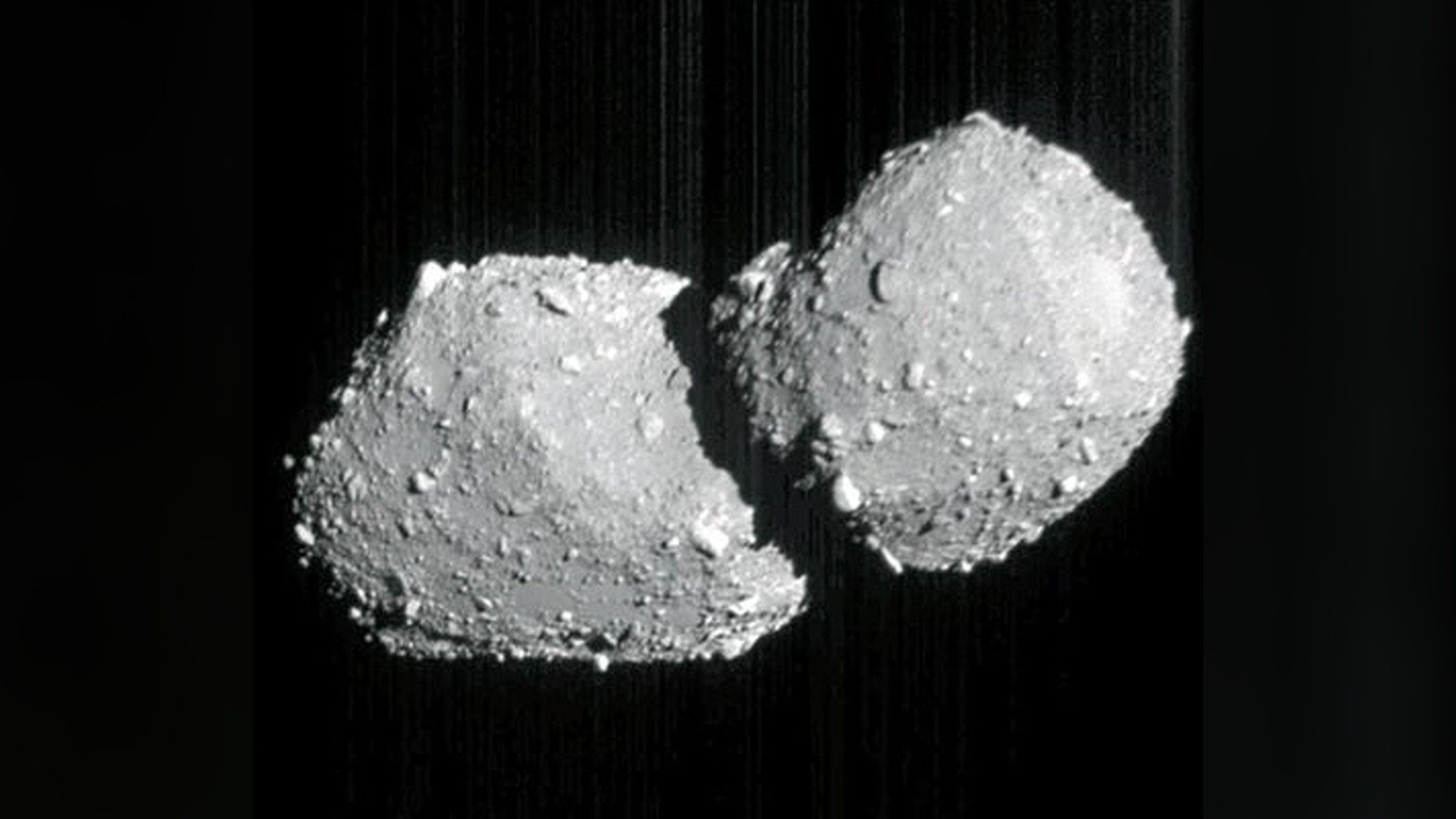
Japan's Hayabusa2 spacecraft completed a risky close flyby of the near-Earth asteroid Torifune on July 5, returning high-resolution images that revealed the target to be a contact binary -- two rocky bodies held together by gravity. The flyby required months of tense negotiation between JAXA's science and engineering teams over how close the aging spacecraft could safely approach. The final decision to pass within 800 meters of the asteroid's center alarmed some scientists, but the mission succeeded and delivered data from all four of Hayabusa2's science instruments, making it a significant technology demonstration for planetary defense work.
The spacecraft, which launched in 2014 and completed its primary mission collecting samples from asteroid Ryugu in 2020, was not originally designed for high-speed flybys. Standard asteroid flybys occur at distances of 100 kilometers, but at that range Hayabusa2's cameras could barely resolve Torifune's shape. Engineers initially proposed 10 kilometers, then confirmed they could reach 1 kilometer. One month before the flyby, mission leader Yuya Mimasu proposed going to 800 meters, triggering heated debate over the unknown size of the target and the risk to the spacecraft.
Hayabusa2's navigation team accounted for substantial uncertainties: ground-based observations suggested a worst-case asteroid size of 1,400 by 400 meters, and the spacecraft's targeting error margin was around 200 meters. The spacecraft's optics had also degraded from dust acquired during sampling at Ryugu. To manage these risks, the team developed new onboard guidance software and switched from ground-based navigation to autonomous targeting in the final three hours before closest approach. The Thermal Infrared Imager captured nine seconds of thermal data just before closest approach, confirming the contact binary structure independently of the optical images.
Most of the 300 megabytes of science data collected during the flyby remains aboard Hayabusa2 and will not reach Earth for months. The spacecraft restarted its ion engines on July 9 and will fire them for roughly four months to begin the cruise toward Earth flybys scheduled for 2027 and 2028. Beyond this extended mission, Hayabusa2 is headed toward a rendezvous with the tiny asteroid 1998 KY26 in