
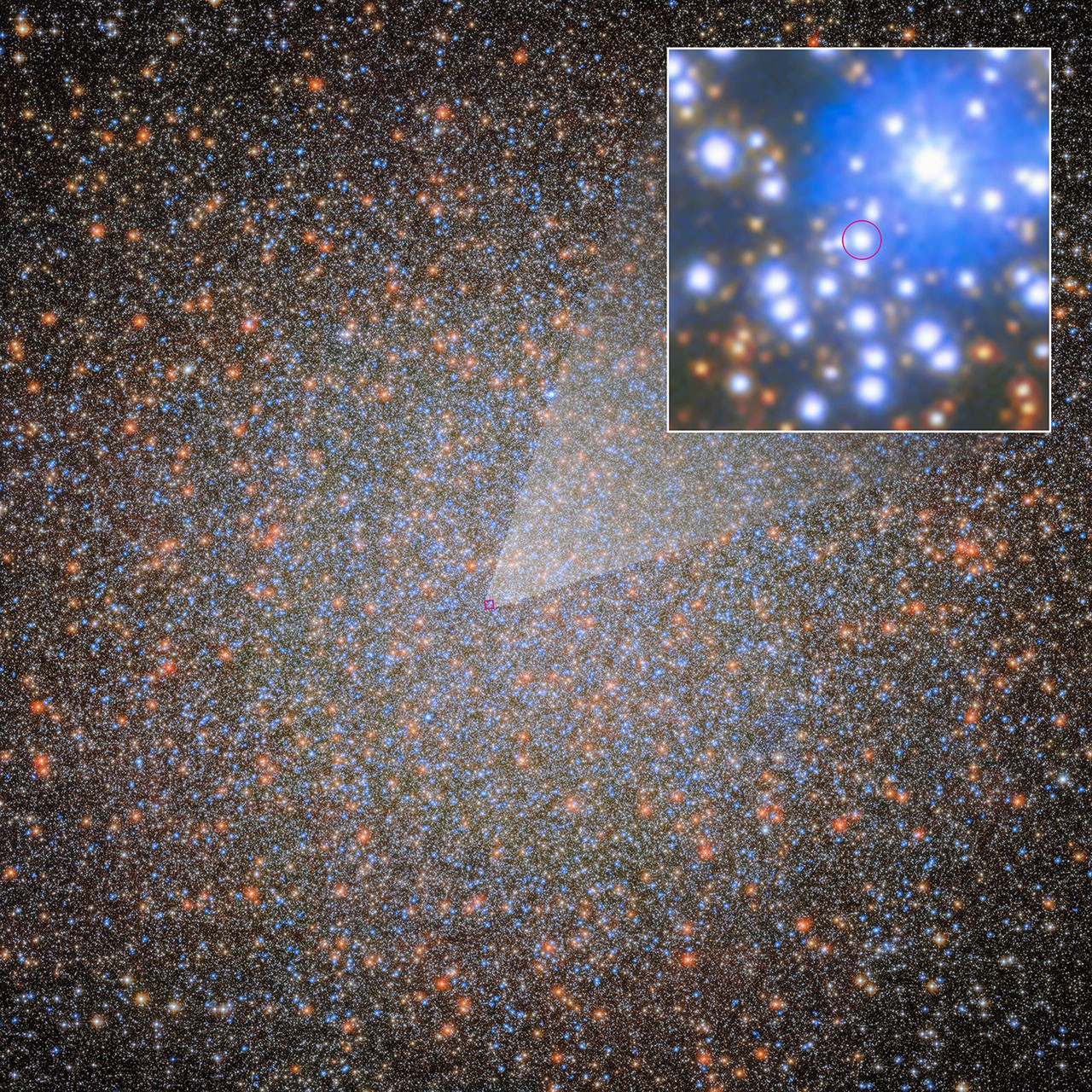
Astronomers using NASA's Hubble and James Webb space telescopes discovered the first stellar-mass black hole in the globular cluster Omega Centauri, solving a decades-old puzzle about a missing population of black holes in the 10-million-star system. The discovery, led by a University of Utah team and published in The Astrophysical Journal Letters, used astrometry to track a visible star's motion over more than 20 years of archival data, revealing it orbits an invisible companion too massive to be anything but a black hole. The finding matters because models predict Omega Centauri should contain roughly 10,000 stellar-mass black holes, yet previous searches using radial velocity and X-ray methods found none.
The black hole, designated oMEGaCat BH-2, has a mass of 4.46 solar masses -- unexpectedly low for a metal-poor environment like Omega Centauri and ruling out an earlier hypothesis that it was a neutron star. Its visible companion, a 0.78 solar-mass star, orbits once every 94 years, the longest-period black hole binary known to date. The researchers determined the system likely formed dynamically when unrelated objects encountered each other in the cluster, and will survive less than a billion years before nearby star encounters tear it apart. The team plans to search for similar systems using Hubble and Webb data, and expects NASA's incoming Nancy Grace Roman Space Telescope to accelerate discoveries in crowded stellar environments.