
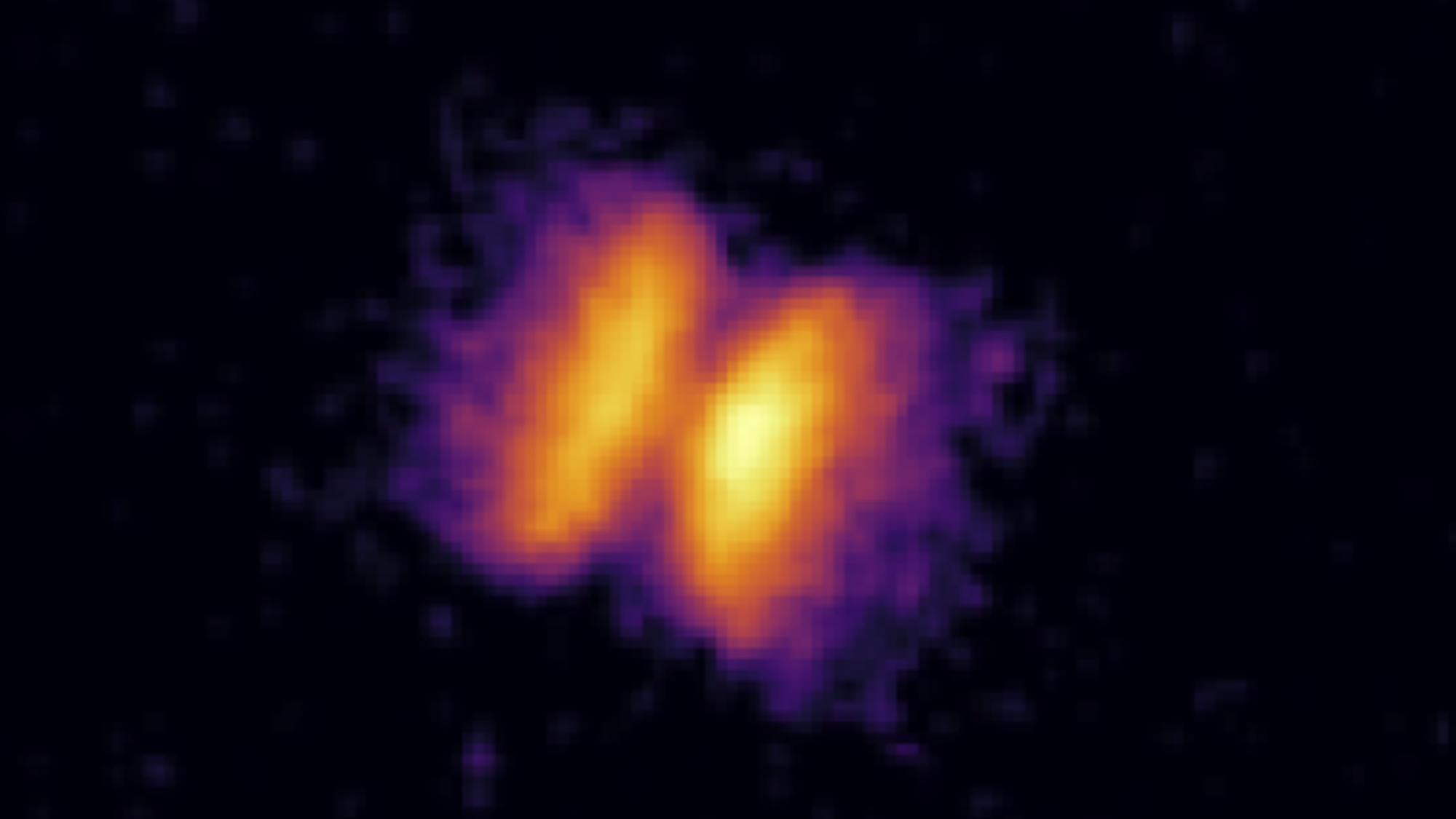
Using NASA's Hubble Space Telescope along with TESS and the Very Large Telescope, astronomers have observed the aftermath of V445 Puppis, a helium nova that erupted in 2000 and remains the only known helium nova in the Milky Way. The observation revealed high-velocity "bullets" of gas traveling at 20 million miles per hour -- clumps the team suspects originated after the outburst. The discovery also confirmed that V445 Puppis contains a white dwarf feeding on a rare helium star, a binary system configuration only found among a few thousand stripped stellar bodies out of billions of stars in the galaxy. The findings resolve a 25-year mystery about the source of the explosion, which had been obscured by a thick dust cloud that took decades to clear.
A helium nova differs fundamentally from ordinary novas. In V445 Puppis, the white dwarf strips helium-rich material from a companion star that has already shed its hydrogen outer layer. This material accumulates on the white dwarf's surface until runaway pressures and temperatures trigger a thermonuclear explosion. The 2000 eruption launched vast bipolar debris plumes stretching more than a trillion miles, initially visible only in infrared.
The "cosmic bullets" observed around V445 Puppis are unprecedented -- no other nova has produced ejecta of this kind. The team, led by John Mills of the University of Warwick, noted that the origin of these bullets remains uncertain, though they likely formed after the outburst itself.
Mills found that the white dwarf has resumed feeding on its helium star companion, suggesting another helium nova could occur soon. This matters because repeated helium nova eruptions are theorized to eventually trigger a Type Ia supernova, which destroys the white dwarf entirely. Type Ia supernovas serve as standard candles for measuring cosmic distances and studying dark energy, making any new understanding of their precursors valuable to cosmology. The research was presented this week at the Royal Astronomical Society's National Astronomy Meeting in Birmingham.