
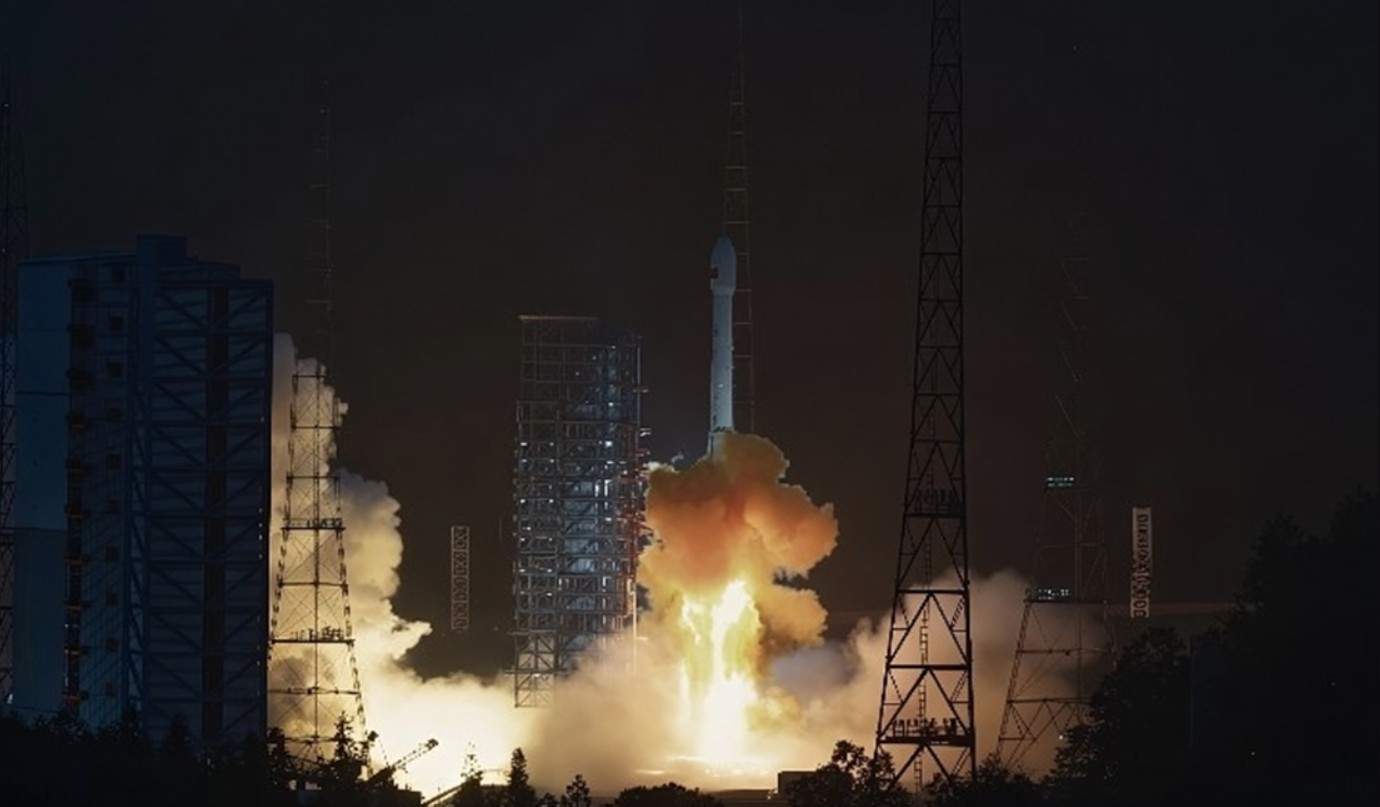
China launched two rockets in a single day Thursday, with a Long March 3B successfully delivering the Tianlian-2 (06) relay satellite to geostationary transfer orbit despite being struck by lightning roughly 30 seconds after liftoff from Xichang. Amateur video captured the lightning strike, an event reminiscent of Apollo 12 in 1969 and a 2019 Soyuz launch, though unlike the 1987 Atlas-Centaur 67 failure, this mission reached its intended orbit. The Tianlian-2 (06) satellite will provide communications relay and tracking support for crewed spacecraft and the Tiangong space station as part of China's second-generation geostationary relay constellation.
Hours later, a Kinetica-1 solid rocket rideshare mission launched from Jiuquan, delivering five satellites to orbit. The flight carried Chenguang-1, a space computing satellite for Beijing Orbital Chenguang Technology; Gande-1 (01), described as China's first commercial space debris monitoring satellite built jointly by Liangxi Aerospace and Aotian Technology; Xiguang-2 (03), a high-resolution infrared remote sensing satellite; Jitianxing A-04, an intelligent computing satellite from Zhejiang Lab; and Yinglong Fengguang-1, a commercial meteorological satellite with humidity sounder and infrared imaging capability.
The Kinetica-1 mission underscores momentum in China's commercial space segment. Orbital Chenguang secured $8.4 billion in credit lines in April for its orbital data center plans, while the debris monitoring satellite reflects growing attention to space traffic management in Earth orbit. CAS Space, the launch provider, told Global Times it plans regular monthly launches through the second half of 2026.
These launches were China's 50th and 51st orbital attempts this year, part of an effort to exceed 100 launches annually for the first time. The pace reflects both government missions and an expanding commercial launch sector, though exact timelines for achieving the 100-launch target remain uncertain.