
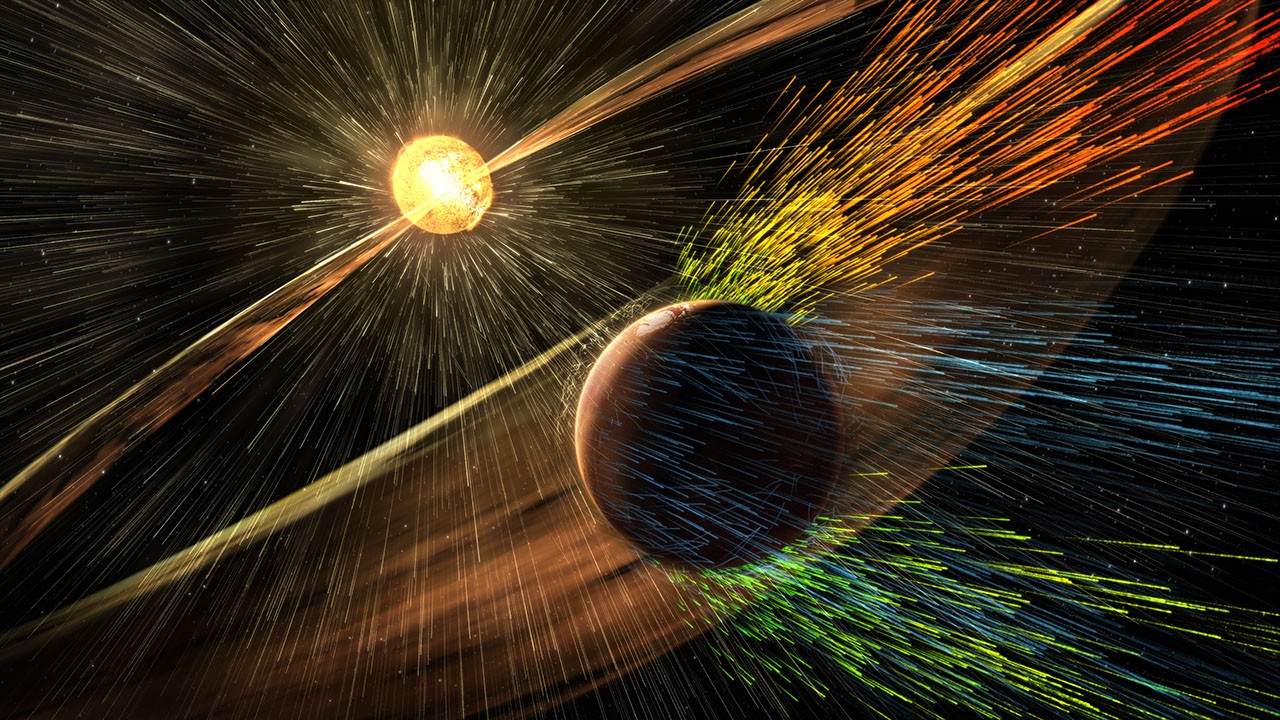
NASA's MAVEN mission has identified how auroras form at Mars, finding they develop through the same mechanism that creates Earth's auroras despite Mars lacking a global magnetic field. Results published in Nature Communications show that a scaled-down version of the Dungey cycle -- the process that circulates charged particles in Earth's magnetosphere and drives aurora generation -- operates over Mars' crustal magnetic fields. MAVEN, which lost signal in December 2025 and was declared concluded in June 2026, collected the data now revealing this physics.
The Dungey cycle works when the Sun's magnetic field reconnects with a planet's magnetosphere, injecting energy that accelerates electrons into the atmosphere. On Earth, this process operates on a planetary scale, but at Mars the same mechanism functions in miniature across localized crustal magnetic fields scattered around the planet. These fields formed about 4 billion years ago when lava cooled in the presence of Mars' ancient global magnetic field, which has since dissipated due to solar wind erosion.
Scientists used three MAVEN instruments to map this behavior: the Magnetometer and Solar Wind Electron Analyzer to determine magnetic configuration and electrical currents, and the STATIC instrument to measure ionospheric plasma flows. The STATIC data proved crucial, according to lead author Shaosui Xu of UC Berkeley's Space Sciences Laboratory, in solving how electrons were being energized to create the observed localized auroras over these crustal fields.
The finding reveals that Dungey-cycle mechanisms can operate at both large and small scales across the solar system. Understanding how the solar environment interacts with Mars through this process helps scientists explain why Mars and Earth evolved differently and informs planning for future robotic and human exploration missions to the Red Planet.