
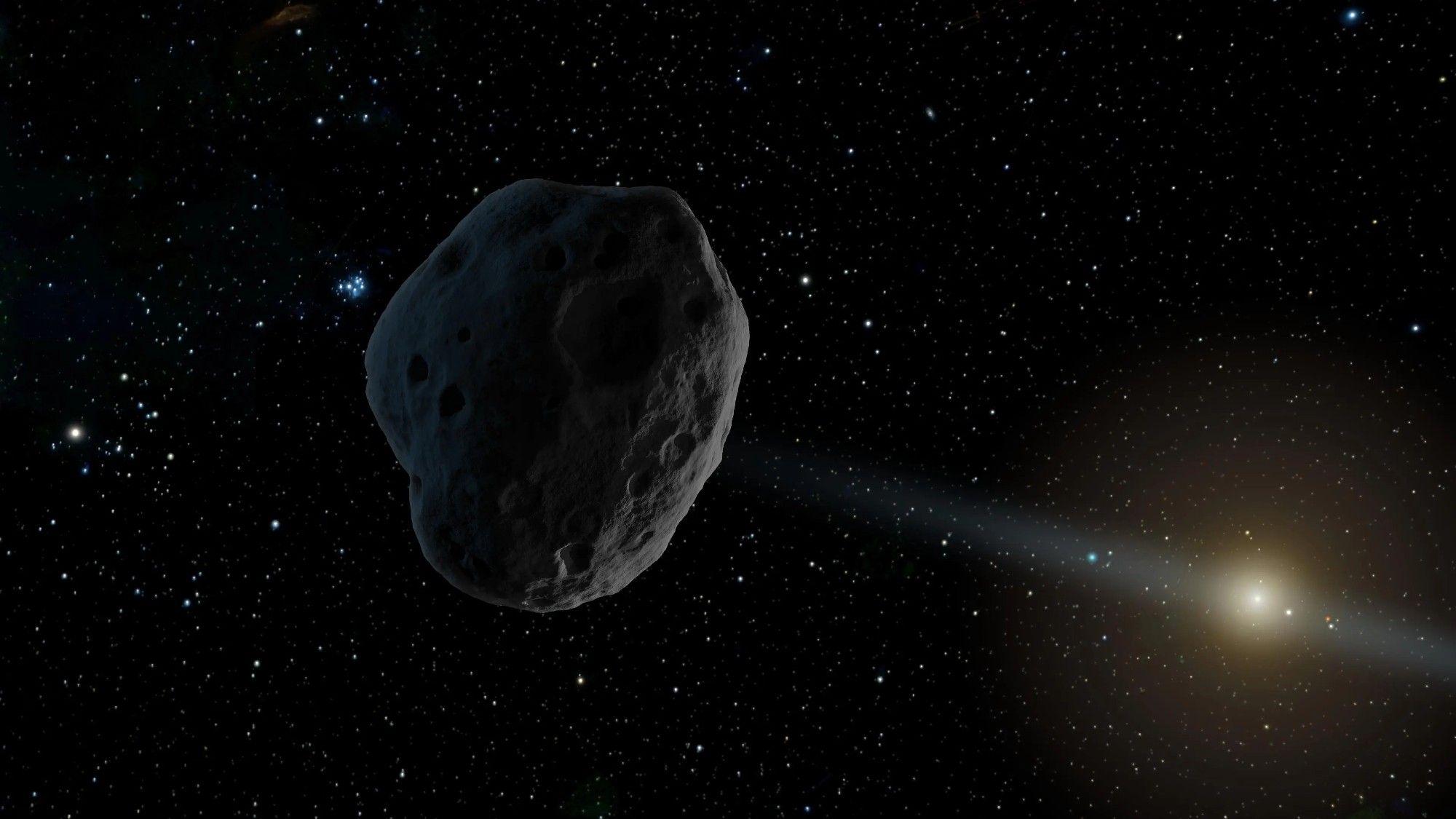
NASA's Deep Space Network planetary radar detected unexpected orbital irregularities in object 1998 SH2 during an August 2025 close approach, prompting researchers to reinvestigate what had been classified as an asteroid for nearly three decades. Precision optical astrometry spanning decades revealed nongravitational forces inconsistent with purely gravitational motion, pointing instead to gas jets escaping from warming surface ice. Observations with the European Southern Observatory's Very Large Telescope and the Canada-France-Hawaii Telescope confirmed a faint but distinct comet tail, officially reclassifying 1998 SH2 as comet P/1998 SH2. The discovery matters for planetary defense because it highlights how comets' outgassing can subtly alter trajectories in ways that pure gravity calculations miss.
Detecting these nongravitational perturbations allows scientists to more accurately predict future orbits and assess potential impact risk, according to Davide Farnocchia, the navigation engineer at NASA's Center for Near-Earth Object Studies who led the study published in Nature Astronomy on July 10. Unlike rocky asteroids, active comets experience additional forces from vaporizing surface material, making their orbital evolution harder to predict using gravity models alone. The object follows a 4.5-year orbit around the sun and showed no obvious cometary signs such as a glowing coma before the detailed analysis began.
The researchers suggest 1998 SH2 may not be an isolated case. Increasingly precise astrometry of near-Earth objects could reveal more hidden comets currently misclassified as asteroids because they lack prominent tails or luminous atmospheres. As the population of tracked near-Earth objects grows, subtle orbital changes may prove as diagnostic as obvious comet features in identifying objects previously missed.
The finding underscores the value of continuous monitoring and detailed tracking in near-Earth object surveillance. Farnocchia noted in the NASA statement that improved identification of which objects are comets rather than asteroids and how their orbits evolve will directly inform threat assessments. As astronomers expand their observational capabilities, cases of cosmic mistaken identity like 1998 SH2 may become more common discoveries, refining planetary defense strategies over time.