
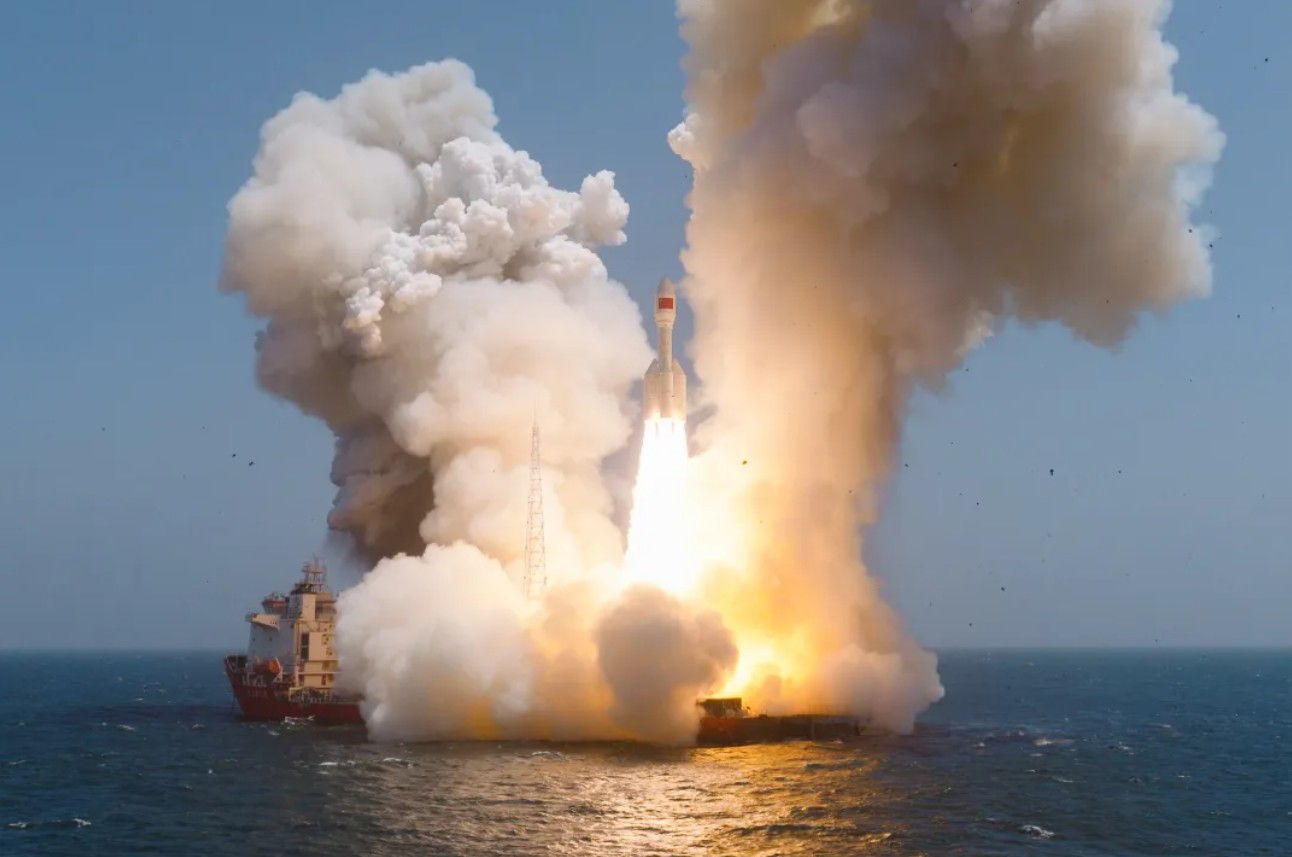
Orienspace launched its third Gravity-1 solid rocket late Tuesday from a ship in the East China Sea off Shanghai, delivering nine satellites to orbit. The mission marked the company's first long-range sea launch operation, moving beyond earlier attempts closer to coastal facilities. The payload included six Dongpo satellites for the Huantian constellation -- two optical satellites with AI-based target recognition and four SAR satellites for surface deformation monitoring -- along with hyperspectral, Earth observation, and experimental platforms from various Chinese operators.
MinoSpace built the Dongpo satellites under a $111 million contract awarded in 2025. The additional payloads included Xiguang-2, a hyperspectral sensor from Xi'an CAS Xiguang Aerospace Technology Group, Tianyi-49 from Spacety, and Lilac-3, an experimental flat-disk satellite from researchers at Harbin Institute of Technology and Beijing Taikonlink Technology. The Huantian constellation aims to provide rapid-response Earth observation capabilities.
The launch occurred amid a busy period for Chinese spaceflight. A Long March 4B deployed the Haiyang-2E oceanography satellite on July 1, and two separate Long March missions launched batches of Qianfan megaconstellation satellites on July 4 and July 5, bringing the constellation total to 238 operational satellites. China completed its 49th orbital launch of 2026 with this flight, including three failures.
Orienspace is developing the Gravity-2 two-stage reusable liquid-fueled launcher, now targeted for Q4 rather than the previously planned late 2025 debut. Meanwhile, the Long March 5 carrying the Chang'e-7 lunar south pole lander arrived at Wenchang on July 13, with a launch window opening at 8:00 p.m. Eastern on August 23. China is on pace to exceed 100 orbital launches in 2026, surpassing its 2025 record of 92 launches.