
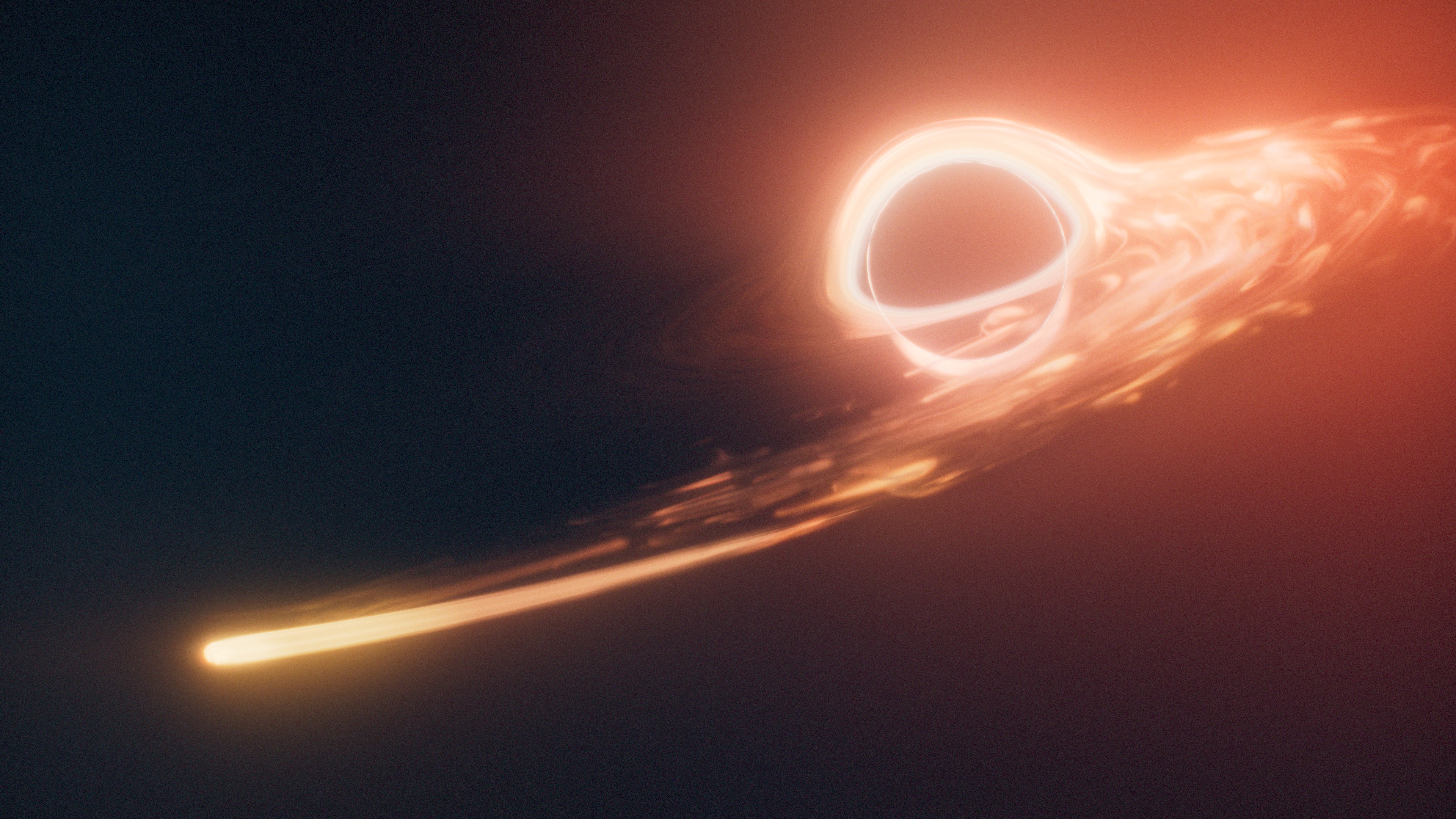
NASA's Roman Space Telescope, scheduled to launch Aug. 30, 2026, will detect distant supermassive black holes up to 11 billion years old by observing tidal disruption events — moments when black holes shred and consume stars, causing them to brighten dramatically. Researchers led by Mitchell Karmen at Johns Hopkins University modeled how Roman's High-Latitude Time-Domain Survey can identify these transient events across cosmic history, providing crucial data on how supermassive black holes form and grow. The work, published in The Astrophysical Journal, addresses a major mystery: how truly enormous black holes existed so early in the universe that current theories struggle to explain their rapid formation.
Roman observes near-infrared wavelengths, which allows it to detect tidal disruption events whose light has been stretched by cosmic expansion — making it sensitive to events from 8 to 11 billion years ago. The team forecasts Roman will detect roughly 100 tidal disruption events per year, far fewer than the ground-based Vera C. Rubin Observatory (which will find thousands to tens of thousands annually in visible light) but at much greater distances and earlier cosmic times. Roman's observations will help distinguish between competing theories of black hole origins: the "light seeds" model, where black holes grow from stellar-mass seeds through mergers and accretion, and the "heavy seeds" model, which proposes they form directly from collapsing gas clouds at much higher initial masses.