
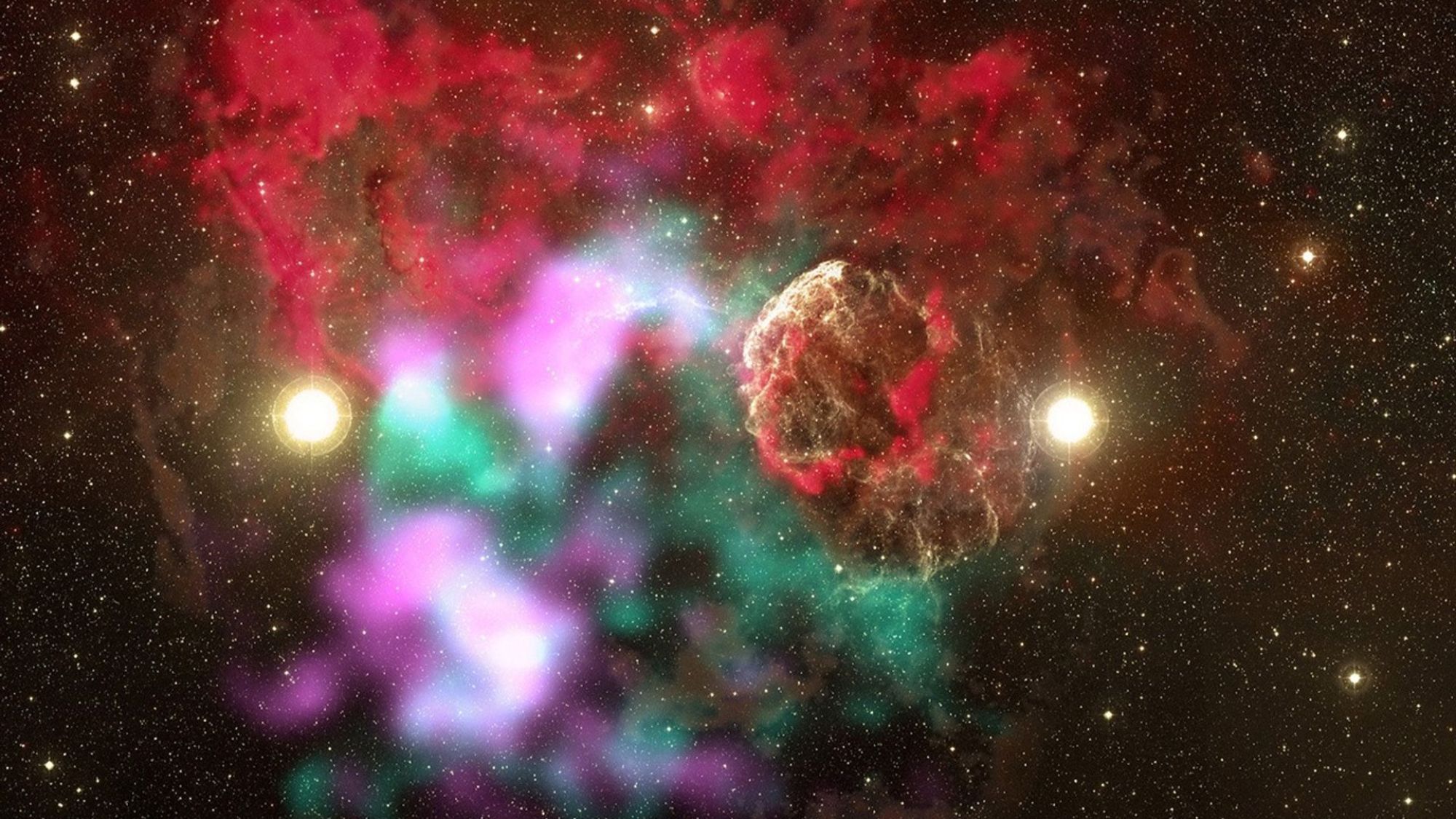
Scientists may have identified the first binary star system where both stars exploded as supernovas, according to a study published July 21 in Nature Communications. The discovery involves two supernova remnants, IC 443 and G189.6+3.3, located about 6,000 light-years away in the constellation Gemini. Researchers led by Miltiadis Michailidis at Stanford University analyzed data showing both remnants are colliding with the same interstellar hydrogen cloud, positioning their explosion centers roughly 30 to 50 light-years apart. The statistical odds of finding two unrelated supernova remnants at this distance runs about one in 1,000, suggesting they originated from a single binary system.
The team examined over 16 years of gamma-ray data from NASA's Fermi telescope plus earlier X-ray, optical, and radio measurements. The older remnant, G189.6+3.3, came from a star that exploded between 20,000 to 110,000 years ago, while IC 443 formed around 8,000 to 9,000 years ago. Both parent stars likely had masses exceeding 20 times the sun's mass.
Binary supernova pairs have eluded detection until now for practical reasons. When two stars explode in close proximity, their supernova remnants can appear as a single explosion rather than distinct objects. Additionally, the first explosion may kick its companion far enough away to obscure evidence they were ever paired. More than half of all stars exist in multiple-star systems, with even higher percentages among massive stars, making paired supernovas statistically likely.
The discovery opens avenues for studying how massive binary stars evolve, interact, and die. Further analysis of G189.6+3.3 and IC 443 could reveal how much momentum the earlier explosion imparted to its companion, offering insights into binary star physics that cannot be gathered from single-star observations.