
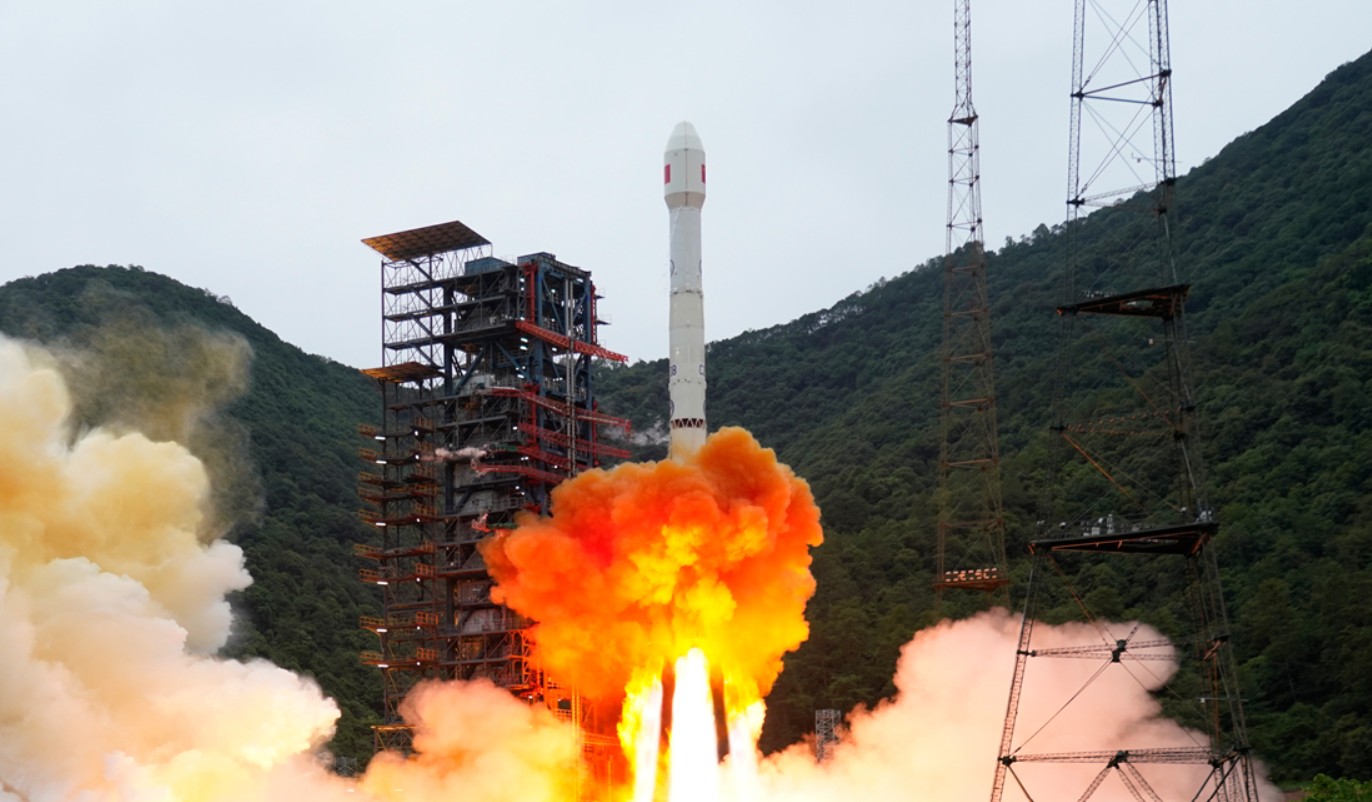
China launched a classified satellite called Shijian-31 on June 16 aboard a Long March 3B rocket, which analysis shows is operating in a modified Molniya orbit to conduct sweeps of geostationary orbit. Integrity ISR and space situational awareness firm ComSpOC identified the satellite using an orbital mechanics approach never publicly documented before -- applying the Molniya concept to monitor GEO rather than maintain long-term viewing over a polar region. The move signals Chinese mastery of orbital mechanics and fits a broader trend of nations developing inspector satellites for GEO surveillance, per Victoria Samson of the Secure World Foundation.
Traditional Molniya orbits use a 63.4-degree inclination to keep a satellite's apogee (farthest point) locked over the northern hemisphere, enabling long viewing periods without fuel-intensive station-keeping maneuvers. China's Shijian-31 adapts this principle to place its apogee over the equator at roughly 39,900 kilometers, allowing it to linger over the GEO belt at 35,786 kilometers altitude. The satellite completes one orbit every 12.5 hours, shifting about 15.7 degrees in longitude with each pass, enabling it to sweep the entire GEO belt once approximately every 23 days.
Observing Shijian-31 directly will be difficult; its perigee sits just under 2,000 kilometers and it passes thousands of kilometers away from U.S. GSSAP inspector satellites in GEO. However, a small retrograde burn of just 50 meters per second at perigee could lower its apogee to roughly 36,671 kilometers, allowing it to pass directly through the GEO neighborhood if China chooses to do so. Samson noted the mission remains hard to characterize with limited information, though it may reveal more details through observable behavior and activities over time.
China operates other Shijian satellites in GEO believed to perform space situational awareness, and Russia operates the Luch 2 inspector satellite following the loss of its Luch (Olymp) predecessor in January. Shijian-31 appears nominally classified as an experimental spacecraft for "space environment exploration," consistent with the broader Shijian series, which has supported refueling tests