
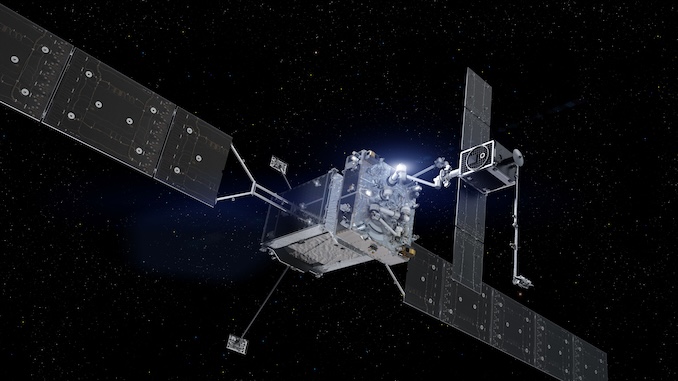
SpaceX is launching Northrop Grumman's Mission Robotic Vehicle (MRV) and three Mission Extension Pods (MEPs) on a Falcon 9 from Cape Canaveral on Tuesday, marking the debut of a satellite servicing mission designed to extend the operational lives of geosynchronous spacecraft. The MRV carries robotic arms developed by the Naval Research Laboratory with DARPA funding, equipped to install MEPs onto client satellites including those operated by Optus and SES. After a year-long transit to geosynchronous orbit, the MRV will begin installing MEPs, which supply fresh maneuvering fuel to provide up to eight years of additional satellite life. This addresses a practical problem in the GEO constellation: aging satellites that still function but lack propellant to maintain station-keeping.
The mission will use Falcon 9 booster B1069 on its 32nd and final flight. SpaceX cited the additional performance needed to reach geosynchronous transfer orbit as the reason for retiring the booster, which previously launched 27 batches of Starlink satellites plus payloads for NASA, Eutelsat, OneWeb, and SES. Liftoff is scheduled during a four-hour window opening at 5:15 p.m. EDT from Space Launch Complex 40.
The RSGS concept traces back over 20 years to Naval Research Laboratory studies on autonomous rendezvous and docking, evolving through programs called RescueSat, SUMO, and FREND. The key innovation was targeting the launch vehicle interface plane -- the structural attachment points where all satellites connect to rockets -- allowing robotic arms to grapple almost any spacecraft without damaging sensitive instruments. Alliance Spacesystems, the company that built arms for NASA's Mars Curiosity Rover, developed the spaceflight-ready robotic arms, with environmental testing beginning in 2008.
DARPA selected SpaceLogistics, a Northrop Grumman subsidiary, in 2019 to combine the RSGS payload with the MRV platform. Following initial in-orbit checkout, the program will transfer to the U.S. Space Force as part of its Servicing, Mobility, and Logistics portfolio.
- Vehicle: Falcon 9 Block 5 (B1069)
- Payload: Mission Robotic Vehicle (MRV) with Robotic Servicing of Geosynchronous Satellites (RSGS) payload and three Mission Extension Pods (MEPs)
- Site: Cape Canaveral Space Launch Complex 40 (SLC-40)
- Orbit: geosynchronous transfer orbit
- Window: 2026-07-22T21:15:00Z
- Customer: Northrop Grumman (vehicle operator); Optus and SES (MEP clients)
- Outcome: upcoming