
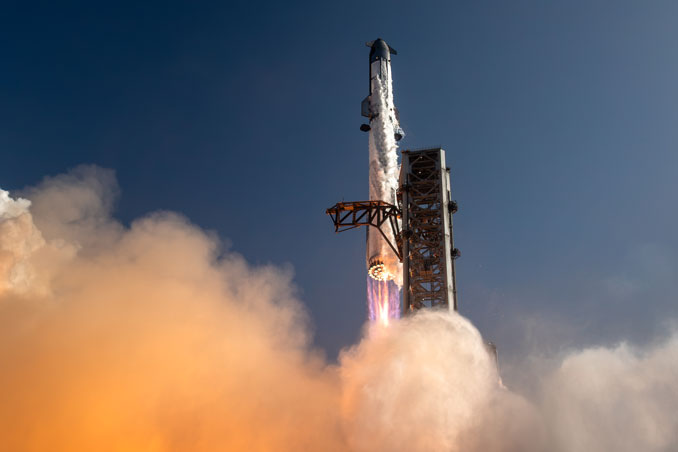
SpaceX completed its 13th Super Heavy-Starship test flight Friday from Starbase in Texas, with the booster achieving an on-target but hard splashdown in the Gulf of Mexico while the upper stage successfully deployed 20 Starlink satellites and completed a sub-orbital hop to the Indian Ocean. All 33 first-stage Raptor engines ignited normally after a launch abort on July 16 due to engine start failures and a 24-hour weather delay. The flight represented the second test of the third-generation V3 rocket, building on lessons from May's initial V3 flight. The booster's performance matters because NASA depends on a Starship variant as the lunar lander for its Artemis program.
The booster's descent ran into trouble when only 10 of 13 engines restarted, and just five were running at splashdown, causing the hard impact. For future crewed missions, the booster needs to perform a slow, controlled descent to allow giant mechanical arms called "chopsticks" to catch it at the launch pad. SpaceX opted for Gulf splashdowns on early V3 flights as a safety precaution until the system is fully reliable. The upper stage, however, performed cleanly throughout ascent and deployed the 20 Starlinks one at a time from a slot near the nose, with six satellites equipped with cameras to inspect the Starship's heat shield tiles.
The Starship also completed a Raptor engine restart in space, a capability required for lunar missions, then conducted a belly-first re-entry and powered splashdown northwest of Australia roughly 65 minutes after launch. NASA has scheduled a 2028 moon landing target and will need SpaceX to launch up to 15 tanker flights to refuel the lander before it can reach the lunar surface. However, the Government Accountability Office warned Thursday that SpaceX faces major challenges, citing cryogenic fuel management as a top risk and noting the company is more than a year behind schedule on critical design reviews and propellant transfer demonstrations.
No Starship variant has yet reached Earth orbit, and the actual moon lander has never flown. NASA is hedging against delays by also funding Blue Origin's lunar lander, though Blue Origin's New Glenn rocket exploded during engine testing. NASA plans an interim Artemis test flight next year
- Vehicle: Super Heavy-Starship Flight 13 (V3)
- Payload: Starship upper stage with 20 third-generation Starlink satellites
- Site: SpaceX Starbase, Boca Chica, Texas
- Orbit: sub-orbital
- Customer: SpaceX (Starlink operator)
- Outcome: partial-success