
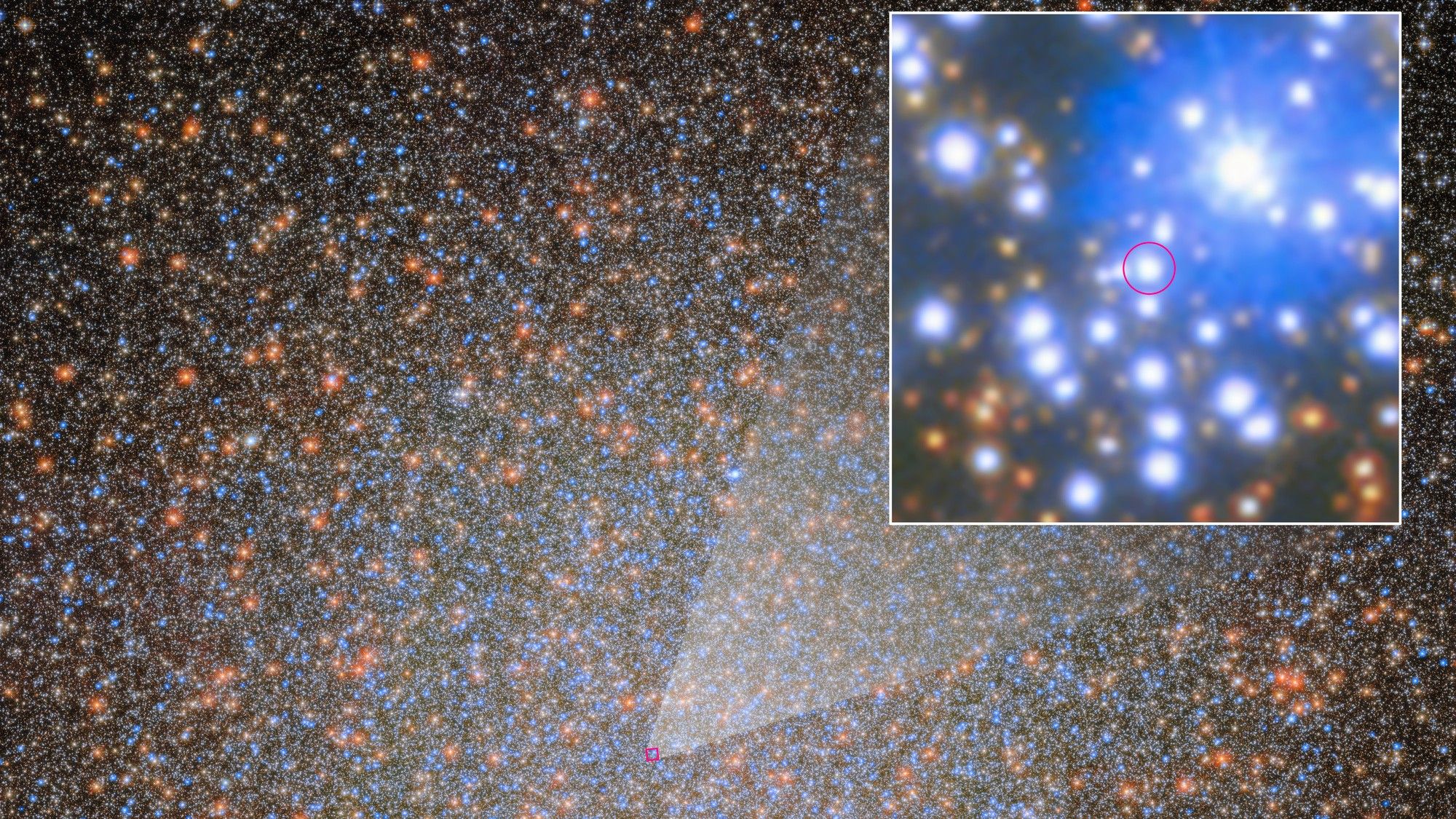
Hubble and the James Webb Space Telescope jointly discovered the first stellar-mass black hole in Omega Centauri, a massive globular cluster 18,000 light-years away. The black hole, called oMEGACat BH-2, was identified by tracking a companion star's motion using astrometry across 20 years of Hubble data plus supporting observations from JWST. The find matters because astronomers predict roughly 10,000 stellar-mass black holes inhabit Omega Centauri, yet this is the first one confirmed in a binary system—a long-standing gap in understanding these dense stellar environments.
The black hole weighs 4.46 times the sun's mass, placing it in a mass range that has rarely appeared in gravitational-wave detections from mergers. Its companion star, 78% of the sun's mass, orbits the black hole over a 94-year cycle—the widest known separation for such a pairing. Matthew Whitaker's team at the University of Utah measured the black hole's gravity by observing how the star accelerated at closest approach. The discovery raises questions about how black holes form from low-metallicity stars like those in Omega Centauri, and suggests the Nancy Grace Roman Space Telescope, launching later this year, could help locate more such systems across the galaxy.